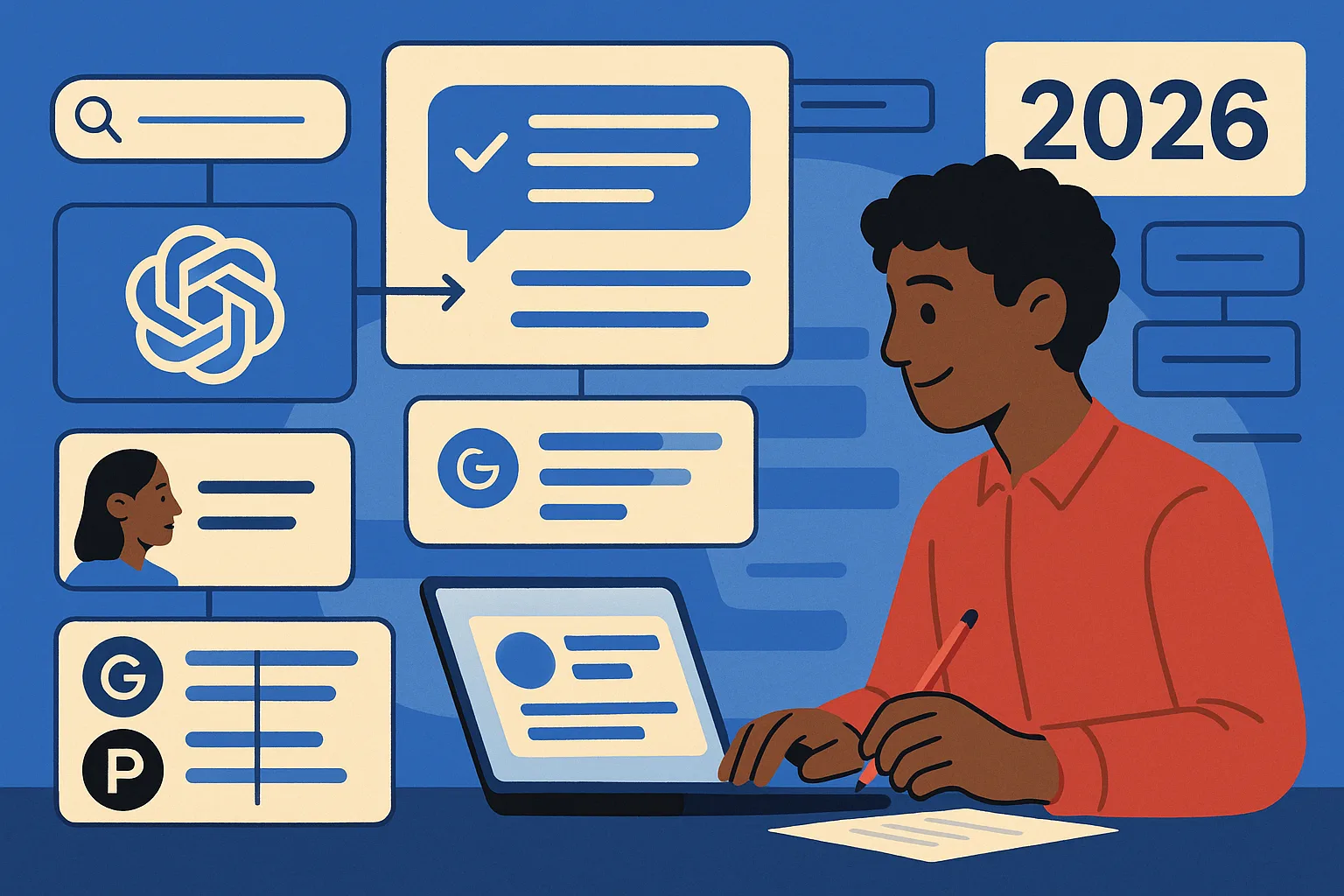
How to Get Better English Answers From ChatGPT, Gemini, and Perplexity in 2026
AI tools are now part of everyday English learning.
Learners use ChatGPT to rewrite emails, Gemini to summarize articles, and Perplexity to explain vocabulary from live sources. That is useful. It is also risky if you use these tools lazily.
Right now, the broader AI world is moving toward structured answers, freshness, and citation-heavy responses. Recent marketing research is making the same point very clearly: AI systems increasingly reward well-formed questions, readable structure, and up-to-date information instead of vague prompts and blind trust. That matters for English learners too.
Because the quality of your English practice now depends on two things:
- the quality of the AI model
- the quality of your question
Most people obsess over the first and ignore the second.
That is a mistake.
If you ask weak questions, you get shallow English. If you ask smart questions, AI becomes an excellent tutor, editor, roleplay partner, and explanation engine.
This guide shows you how to get better English answers from ChatGPT, Gemini, and Perplexity in 2026, and how to avoid the bad habits that make learners sound robotic, overconfident, or simply wrong.
Why AI answers feel better in 2026, and why that can fool you
AI search and conversational tools have improved fast.
Fresh reporting across the AI search space says the winning content formats now include:
- concise explanations
- lists and bullet points
- FAQ structures
- readable formatting
- clear source attribution
- fresher information
That makes AI answers feel more trustworthy.
The problem is obvious once you notice it.
A well-formatted answer is not automatically a good language lesson.
An AI tool can produce:
- correct grammar but unnatural tone
- fluent vocabulary but the wrong level for you
- polished business English that sounds too formal for real life
- explanations that simplify too much
- confident mistakes hidden inside elegant phrasing
So the real goal is not just to get an answer.
The goal is to get an answer that is:
- correct
- level-appropriate
- natural
- useful in context
- easy to verify
What each tool does best for English learners
ChatGPT
Best for:
- conversation practice
- rewriting
- step-by-step grammar explanations
- roleplay
- custom drills
ChatGPT is usually the strongest option when you want iteration. You can ask follow-up questions, change the tone, ask for simpler wording, or build a full study routine.
Gemini
Best for:
- multimodal explanations
- working across Google-style information flows
- summarizing current topics
- comparing explanations across examples
Gemini is useful when you want broad context and quick explanation, especially if you are studying from current web content or mixed media.
Perplexity
Best for:
- source-backed explanations
- fast fact-checking
- vocabulary from real articles
- staying current with live topics
Perplexity is especially useful if you want to learn English from real-world material instead of generic textbook examples.
The smart move is not choosing one forever.
Use:
- ChatGPT for practice
- Gemini for exploration
- Perplexity for verification
The biggest prompt mistake English learners make
Most learners still ask things like:
- Explain the present perfect
- Teach me business English
- Improve this sentence
- Give me advanced vocabulary
These prompts are not wrong.
They are just too vague.
If you ask a broad question, the model has to guess:
- your level
- your goal
- your context
- your deadline
- your preferred style
- whether you want British or American English
That guess is where a lot of bad learning starts.
A stronger prompt includes five things:
- goal
- level
- context
- output format
- correction rule
For example:
I am a B1 English learner. I need to write a polite follow-up email after a job interview. Use natural professional English, not overly formal language. First write the email, then explain 5 useful phrases, then show me a simpler B1 version.
That prompt gives the model a job instead of a theme.
The best prompt frameworks for English practice
1. The level plus task prompt
Use this when you want material that actually fits you.
Template:
I am a [LEVEL] learner. Help me with [TASK]. Use [TONE/VARIETY]. Avoid [PROBLEM].
Example:
I am a B2 learner. Help me prepare for a team meeting in English. Use natural workplace English. Avoid phrases that sound too corporate or unnatural.
Why it works:
- the model chooses more realistic vocabulary
- you reduce generic textbook language
- you get practice you can actually use
2. The compare and explain prompt
Use this when you keep mixing up similar words or grammar patterns.
Example:
Explain the difference between “I have worked,” “I worked,” and “I have been working.” Use simple examples from work and travel. Then give me a short quiz.
Why it works:
AI is very good at contrast. If you ask it to compare instead of define, the explanation gets sharper.
3. The correction with reasons prompt
Never ask only:
- Correct this
Ask instead:
Correct this paragraph. Keep my original meaning. Mark every change in bold. Then explain why each correction was necessary in simple English.
This is one of the best ways to turn AI into a writing coach instead of a ghostwriter.
4. The roleplay prompt
Example:
Roleplay as a hotel receptionist. Ask me one question at a time. After each answer, correct my English briefly and continue the conversation naturally.
This is excellent for speaking practice, especially if you usually freeze in real conversations.
5. The source plus simplification prompt
This is where Perplexity and Gemini become especially useful.
Example:
Find a recent article about AI in travel. Extract 10 useful English words or phrases from it, define them in simple English, and write 5 comprehension questions for a B2 learner.
This gives you current English, not stale classroom language.
How to stop AI from teaching you weird English
This is the trap.
AI often produces grammatically correct but socially strange language.
It may sound:
- too formal
- too dramatic
- too American for your context
- too British for your exam target
- too polished for a normal conversation
To prevent that, add control instructions.
Use prompts like:
- Use natural spoken English
- Make this sound like a real manager, not a textbook
- Rewrite this for a B1 learner in plain English
- Use modern British English
- Tell me if any phrase sounds unnatural in real life
- Give me the version a native speaker would actually say
That last one is especially useful.
Still, do not trust it blindly.
Ask one more question:
Which sentence in your answer sounds the least natural, and how would you improve it?
That forces the model to audit itself.
A better workflow: generate, verify, recycle
Here is a reliable 2026 workflow for learning English with AI.
Step 1. Generate
Use ChatGPT or Gemini to create:
- explanations
- dialogues
- email drafts
- vocabulary lists
- quizzes
Step 2. Verify
Use Perplexity or a second model to check:
- whether the phrase is current
- whether the register fits the situation
- whether a rule was oversimplified
- whether a collocation is common
Example:
Ask ChatGPT:
Write 10 natural phrases for disagreeing politely in a meeting.
Then ask Perplexity:
Which of these phrases are most common in current professional English, and which sound too formal or less natural?
That is how you avoid learning polished nonsense.
Step 3. Recycle
Turn the output into active practice:
- write your own examples
- speak the lines aloud
- turn phrases into flashcards
- ask for a quiz one day later
- ask for a mini test one week later
Passive reading is not enough. AI becomes powerful when you loop its output back into active recall.
How to use AI for the four core English skills
Reading
Use AI to simplify difficult texts without destroying meaning.
Prompt:
Summarize this article in clear B2 English. Then list 8 useful phrases from the text and explain how to use them.
This is great for news, business articles, and technical content.
Writing
Do not let AI write everything for you.
Better prompt:
Review my email like an English coach. Rate it for clarity, tone, grammar, and naturalness from 1 to 10. Then show an improved version and explain the 5 most important changes.
You still do the writing. AI improves it.
Speaking
Use one-question-at-a-time roleplay.
Prompt:
Simulate a job interview for a marketing role. Ask one question at a time. After each answer, give me short feedback on grammar, vocabulary, and confidence.
Listening
Ask the model to build a listening system around real content.
Prompt:
Recommend 3 recent English videos or podcasts for B2 learners interested in technology. For each one, give me key vocabulary, discussion questions, and one shadowing exercise.
The freshness advantage: why current topics help your English
One of the big shifts in AI content right now is that freshness matters more.
That is good news for learners.
Studying only from old exercises creates brittle English. You understand exam language, but not how people actually talk about current reality.
When you use recent topics, for example:
- AI search
- remote work
- travel planning
- creator economy
- business automation
you learn vocabulary that is alive.
This matters for:
- job interviews
- meetings
- university work
- networking
- content creation
A modern learner should spend at least part of each week learning English from live topics, not only from grammar books.
A 20-minute AI English study routine that actually works
If you want something simple, use this.
Minutes 1 to 5
Read a short recent article or summary in English.
Minutes 6 to 10
Ask AI to explain 5 phrases, one grammar pattern, and one tone choice.
Minutes 11 to 15
Write your own paragraph using the new language.
Minutes 16 to 20
Ask AI to correct your paragraph, explain the changes, and quiz you on the same topic.
This routine is short enough to sustain and strong enough to build momentum.
Red flags that mean you are using AI badly
Watch for these warning signs:
- you copy full AI texts without understanding them
- you ask for advanced vocabulary you cannot use naturally
- you never verify phrases with a second source
- you read corrections but do not rewrite anything yourself
- you practice only input, never output
- you sound more formal in English than in your native language
That last point is common and funny. AI loves making people sound like lawyers at a coffee shop.
Final advice: use AI like a coach, not a crutch
The best English learners in 2026 will not be the ones who use the most AI.
They will be the ones who use AI with the best discipline.
That means:
- asking precise questions
- demanding natural language
- checking sources when needed
- turning answers into active practice
- learning from current topics, not only static examples
ChatGPT, Gemini, and Perplexity can absolutely help you improve faster.
But only if you stop treating them like magic and start treating them like tools.
Use them well, and they can compress months of confusion into a few focused study sessions.
Use them badly, and they will help you become wrong more fluently.
That is not progress.
That is just faster confusion.