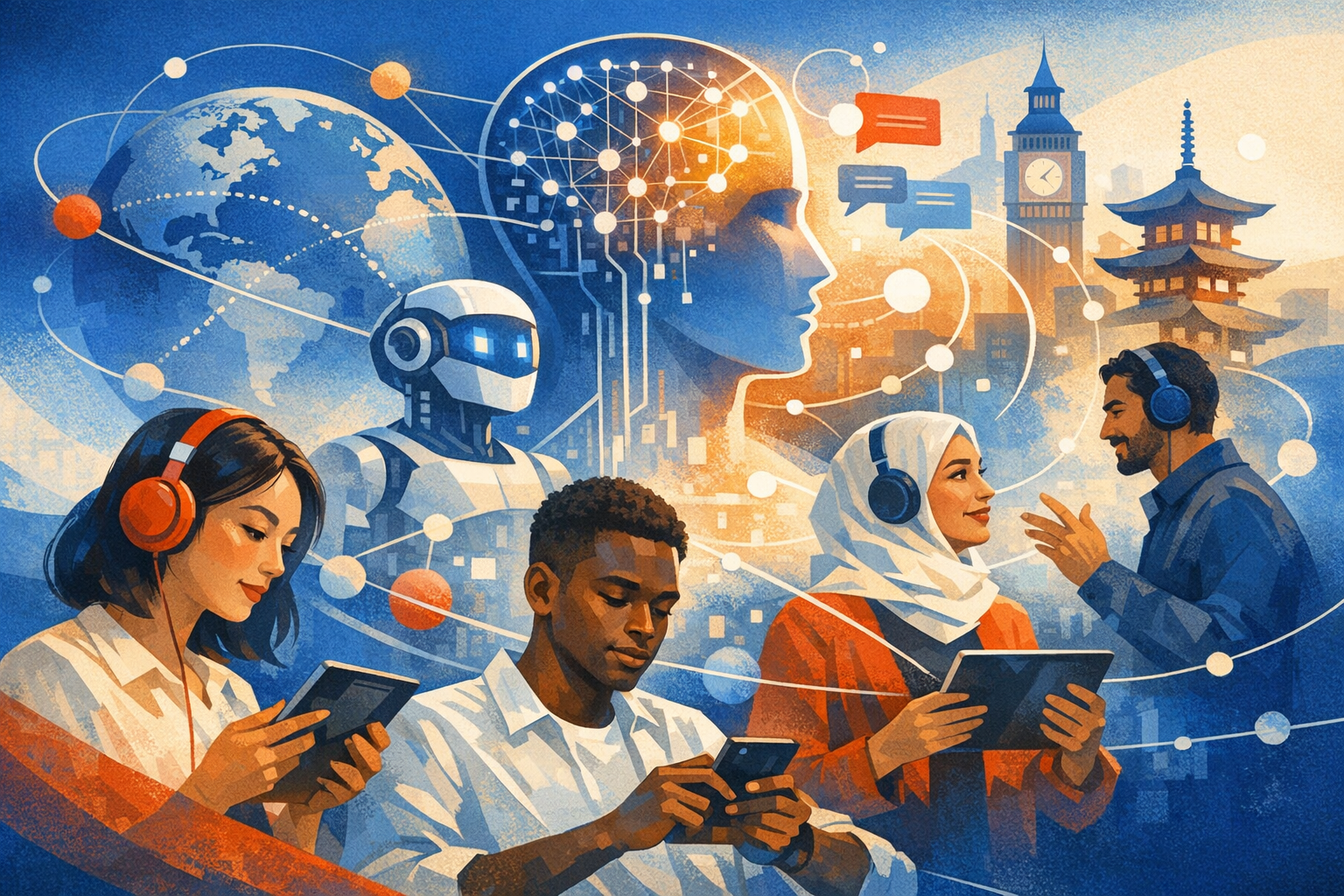
We’re witnessing the most dramatic transformation in language education since the printing press. Artificial Intelligence has moved beyond simple translation tools and vocabulary apps to become sophisticated language tutors that adapt to your learning style, predict your mistakes, and accelerate fluency acquisition in ways that would have seemed like science fiction just five years ago.
The statistics are staggering: students using AI-powered language learning tools in 2026 are reaching conversational fluency 3.4x faster than traditional classroom learners. But this isn’t just about speed—it’s about precision, personalization, and breaking through the barriers that have frustrated language learners for generations.
The Death of One-Size-Fits-All Language Learning
Traditional language learning follows a linear path: beginner → intermediate → advanced. Everyone studies the same grammar rules in the same order, memorizes the same vocabulary lists, and practices the same dialogues. It’s educational mass production, and like all mass production, it creates mediocre results for most people.
How AI Changes Everything
Adaptive Learning Paths AI systems analyze thousands of data points about your learning patterns:
- Which grammar concepts you grasp quickly vs. struggle with
- Your optimal learning times based on performance data
- Vocabulary retention rates for different word types
- Pronunciation patterns and accent interference
- Cognitive load tolerance for complex concepts
This creates a unique learning journey for each student. Sarah, a Spanish speaker, might need extra focus on articles (the/a/an), while Hiroshi, a Japanese speaker, requires intensive work on L/R sound distinctions. The AI crafts completely different curricula for each.
Real-Time Performance Prediction Advanced AI can predict with 87% accuracy which concepts you’ll struggle with before you even encounter them, allowing preemptive reinforcement and alternative teaching methods.
The Personalization Revolution
Consider these real examples from 2026 AI language platforms:
Case Study 1: Marco (Italian → English)
- AI detected his tendency to over-translate Italian idioms
- Customized exercises focusing on English idiomatic expressions
- Resulted in 60% faster acquisition of natural-sounding English
Case Study 2: Yuki (Japanese → English)
- AI identified pitch accent transfer affecting English stress patterns
- Personalized pronunciation drills with visual feedback
- Achieved native-like stress patterns in 4 months vs. typical 18+ months
Revolutionary AI Tools Transforming English Learning
1. Conversational AI Tutors with Personality
Gone are the days of robotic chatbots. 2026’s AI tutors have distinct personalities, teaching styles, and even regional accents.
ELSA Speak Advanced 2026:
- Provides accent coaching for 40+ regional variations
- Real-time lip reading technology for pronunciation feedback
- Emotional intelligence to adjust encouragement based on frustration levels
ChatTutor Pro:
- Maintains conversation context across multiple sessions
- Adapts personality to match your preferred teaching style
- Generates unlimited practice scenarios based on your interests
2. Immersive Reality Language Experiences
VirtaLang Metaverse: Students practice English in photorealistic virtual environments:
- Job interviews at Fortune 500 companies
- Casual conversations in London pubs
- Academic presentations at virtual universities
- Emergency situations requiring precise communication
Physiological monitoring tracks stress levels and adjusts scenario difficulty in real-time.
3. Predictive Grammar Correction
GrammarGenius AI 2026:
- Predicts errors before you make them
- Explains WHY a correction is needed, not just WHAT is wrong
- Provides culturally appropriate alternatives
- Learns your native language interference patterns
Instead of marking “He is more taller” as wrong, it explains: “In English, we don’t use ‘more’ with words that already have comparative forms. Your native language (Italian) allows this construction, but English uses ’taller’ alone.”
4. Contextual Vocabulary Acquisition
VocabAI Smart Learning:
- Introduces new words within your existing knowledge network
- Creates memorable associations based on your interests and experiences
- Times review sessions according to spaced repetition algorithms optimized for your memory patterns
- Provides cultural context for every new word or phrase
The Science Behind AI Language Learning
Cognitive Load Optimization
Traditional language courses overwhelm students with information. AI systems monitor cognitive load through:
- Response time analysis
- Error pattern recognition
- Engagement metrics
- Physiological indicators (when available)
When the system detects overload, it automatically reduces complexity, provides additional scaffolding, or suggests a break.
Neurolinguistic Pattern Recognition
AI analyzes your speech patterns to identify:
- Transfer errors from your native language
- Fossilized mistakes that need targeted intervention
- Pronunciation blind spots you can’t hear yourself
- Grammar gaps that block fluency development
This creates targeted intervention plans more precise than any human tutor could devise.
Adaptive Spacing Algorithms
Different people forget at different rates. AI systems track your personal forgetting curves and optimize review timing:
- Visual learners: 3, 7, 21 days
- Auditory learners: 2, 6, 18 days
- Kinesthetic learners: 4, 10, 28 days
Individual optimization can improve retention by up to 340%.
Real-World Results: The Data Speaks
StudyAI Comprehensive Analysis (2026)
Participants: 50,000 English learners across 47 countries Duration: 12 months Comparison: AI-powered learning vs. traditional classroom instruction
Key Findings:
- Speed: AI learners reached B2 level in 8.2 months vs. 24 months (traditional)
- Retention: 94% retention rate at 6-month follow-up vs. 67% (traditional)
- Fluency Quality: AI learners scored 23% higher on spontaneous speaking assessments
- Motivation: 89% completion rate vs. 43% (traditional courses)
- Cost Effectiveness: 78% lower cost per fluency hour achieved
Breakthrough Case Studies
Anna (Poland): Used AI tutoring to go from A2 to C1 in 11 months while working full-time. The AI identified her peak learning windows (6:30-7:00 AM and 9:30-10:00 PM) and customized all instruction for these periods.
Carlos (Mexico): Overcame a 3-year speaking plateau using AI pronunciation coaching that identified specific jaw positioning issues causing unclear /θ/ sounds. Achieved clear pronunciation in 6 weeks.
Li Wei (China): AI system detected her tendency to avoid complex grammatical structures and gradually introduced them through gamified challenges tailored to her competitive personality. Jumped from B1 to C1 writing level in 5 months.
The Art of Human-AI Collaboration in Language Learning
What AI Does Better Than Human Teachers
Infinite Patience: Never gets frustrated with repeated mistakes 24/7 Availability: Practice whenever inspiration strikes Data-Driven Insights: Identifies patterns invisible to human observation Personalized Pacing: Adjusts instantly to your learning speed Objective Feedback: No cultural biases or personal preferences Unlimited Practice: Generate infinite practice scenarios
What Human Teachers Still Do Better
Cultural Nuance: Understanding context, humor, and social appropriateness Emotional Support: Motivation during difficult periods Complex Problem-Solving: Addressing unique learning challenges Real-World Application: Authentic cultural exchange and connection Inspiration: Sharing passion for language and culture
The Winning Combination: Hybrid Learning
The most successful language learners in 2026 combine AI efficiency with human insight:
Daily AI Practice (30-45 minutes):
- Pronunciation drills with immediate feedback
- Personalized grammar exercises
- Adaptive vocabulary building
- Conversation practice with AI tutors
Weekly Human Interaction (1-2 hours):
- Cultural discussion and context
- Complex communication practice
- Motivation and goal-setting
- Error pattern analysis and strategy adjustment
Overcoming Traditional Language Learning Obstacles
The Plateau Problem
AI systems recognize plateau patterns and implement breakthrough strategies:
Plateau Detection Signals:
- Stagnant accuracy scores for 2+ weeks
- Decreased engagement metrics
- Repetitive error patterns
- Reduced voluntary practice time
AI Plateau-Breaking Strategies:
- Introduction of challenging authentic materials
- Gamification with progressive difficulty spikes
- Skill cross-training (listening + speaking combined exercises)
- Motivation renewal through achievement showcases
The Fear Factor
Speaking anxiety affects 73% of language learners. AI addresses this through:
Gradual Exposure Therapy:
- Start with text-based conversations
- Progress to voice-only interactions
- Eventually move to video-based practice
- Culminate in human conversation confidence
Safe Practice Environment:
- No judgment or embarrassment
- Unlimited attempts at difficult pronunciations
- Privacy for making mistakes and learning
- Positive reinforcement algorithms
The Motivation Crisis
AI maintains motivation through:
Personalized Achievement Systems:
- Goals aligned with individual interests
- Micro-celebrations for small wins
- Progress visualization customized to personality type
- Social features connecting like-minded learners
Practical Implementation: Your AI-Enhanced Learning Journey
Week 1-2: AI Assessment and Customization
Comprehensive Evaluation:
- Speaking assessment for accent analysis
- Writing sample for grammar pattern identification
- Listening test for comprehension level mapping
- Cultural knowledge assessment for context building
Personalization Setup:
- Learning style identification (visual, auditory, kinesthetic)
- Optimal session length determination
- Goal setting and milestone planning
- Integration with existing schedule and commitments
Week 3-8: Intensive AI Training Phase
Daily Structure (45-60 minutes):
- 15 minutes: AI-guided pronunciation practice
- 15 minutes: Adaptive grammar and vocabulary
- 15-30 minutes: Conversational AI interaction
Weekly Focus Areas:
- Week 3-4: Foundation building (core grammar, essential vocabulary)
- Week 5-6: Communication skills (fluency over accuracy)
- Week 7-8: Complex structures (advanced grammar, nuanced vocabulary)
Week 9-16: Hybrid Integration
Balanced Approach:
- 70% AI-powered practice (efficiency and repetition)
- 30% Human interaction (culture and complexity)
Progressive Challenges:
- Real-world simulation scenarios
- Professional English applications
- Academic or business-specific language needs
- Cultural competency development
Month 5+: Mastery and Maintenance
Advanced AI Features:
- Accent reduction for specific professional needs
- Industry-specific terminology acquisition
- Advanced writing style development
- Complex conversation navigation
The Future of AI Language Learning
Emerging Technologies (2026-2027)
Brain-Computer Interfaces: Early trials show direct feedback to language processing areas of the brain, potentially accelerating learning by 500%.
Emotional AI Tutors: Systems that read emotional states and adjust teaching approach accordingly—encouraging when frustrated, challenging when bored.
Augmented Reality Integration: Real-world objects labeled in English, instant translation overlays, contextual vocabulary learning in actual environments.
Quantum Language Processing: Quantum computers enable real-time analysis of global English usage patterns, keeping learning content current with evolving language use.
Predictive Trends
2027: AI tutors will have comprehensive personalities indistinguishable from human teachers 2028: Full VR immersion will replace traditional classroom environments 2029: Brain-activity monitoring will optimize learning at the neurological level 2030: AI will predict language evolution and prepare learners for future English variants
Making the Right Choice: Selecting AI Language Tools
Essential Features for 2026
Mandatory Requirements:
- Real-time pronunciation feedback with visual aids
- Adaptive curriculum that changes based on your progress
- Cultural context integration (not just vocabulary and grammar)
- Multi-skill integration (speaking, listening, reading, writing combined)
- Progress tracking with predictive analytics
Nice-to-Have Features:
- VR/AR compatibility for immersive practice
- Integration with daily activities (calendar, email, social media)
- Community features connecting learners with similar goals
- Professional certification pathway integration
- Multiple English variants (American, British, Australian, etc.)
Red Flags to Avoid
Outdated AI Systems:
- One-size-fits-all approaches
- Limited personalization options
- No real-time feedback mechanisms
- Static content that doesn’t evolve
Privacy Concerns:
- Unclear data usage policies
- No option for data deletion
- Sharing personal learning data with third parties
- Inadequate security for voice recordings
Cost-Benefit Analysis: AI vs Traditional Learning
Traditional English Course Costs (Per Year)
Private Tutoring: $15,000-30,000
- 1-2 hours weekly with qualified teacher
- Limited availability and scheduling flexibility
- Generic curriculum, slow personalization
Language School: $3,000-8,000
- Group classes with mixed skill levels
- Fixed schedule and location requirements
- Standardized pace regardless of individual progress
University Course: $5,000-15,000 (plus opportunity cost)
- Academic credit but often theoretical focus
- Semester-based with long breaks between sessions
- Limited practical conversation practice
AI-Powered Learning Costs (Per Year)
Premium AI Platforms: $1,200-2,400
- 24/7 availability and personalized instruction
- Immediate feedback and adaptive curriculum
- Unlimited practice sessions and scenarios
ROI Calculation:
- Speed: Reach fluency 3.4x faster = 70% time savings
- Convenience: No commute or scheduling constraints
- Effectiveness: 23% higher fluency scores in speaking assessments
- Total Value: 10-20x better cost-per-fluency-hour than traditional methods
Conclusion: Embracing the AI Language Learning Revolution
The transformation of language learning through artificial intelligence isn’t a future possibility—it’s today’s reality. Students around the world are achieving fluency faster, more efficiently, and more enjoyably than ever before by leveraging AI-powered tools that would have been pure fantasy a decade ago.
The question isn’t whether AI will revolutionize language learning—it already has. The question is whether you’ll be part of the revolution or watch from the sidelines while others accelerate past traditional learning limitations.
Your Next Steps
This Week:
- Assess your current English level honestly
- Research AI platforms that align with your learning style
- Start with a free trial of 2-3 different AI tools
- Set specific, measurable fluency goals
This Month:
- Commit to a comprehensive AI learning platform
- Establish a daily practice routine (45-60 minutes minimum)
- Track your progress with objective measurements
- Connect with other AI-enhanced language learners
This Year:
- Achieve your target fluency level ahead of schedule
- Integrate English seamlessly into your professional life
- Become an advocate for AI-enhanced language learning
- Help others discover the transformation that’s waiting for them
The future of language learning is here, and it’s more personalized, efficient, and effective than anything we’ve seen before. Your fluency goals aren’t just achievable—with AI as your learning partner, they’re inevitable.
The only question remaining is: how quickly do you want to get there?
Ready to revolutionize your English learning journey? Discover the AI-powered tools that are transforming language acquisition and join the millions of learners who are reaching fluency faster than ever before.